Is Laser Hair Removal Safe? Complete Safety Guide for 2026
Is laser hair removal safe? This question matters when you’re considering a treatment that uses concentrated light energy to target hair follicles. The safety of laser hair removal depends on multiple factors: the type of laser used, your skin tone, the qualifications of your technician, and how well you follow pre-treatment and aftercare protocols. Modern laser hair removal, when performed by certified professionals using Health Canada-compliant equipment, has an excellent safety profile backed by decades of clinical research. This guide covers everything you need to know about laser hair removal safety, from FDA approval and medical evidence to skin type considerations, potential risks, contraindications, and how to choose a qualified provider in Ontario.
At Bright and Beauty Laser Clinic in North York, Soraya and her team prioritize safety through thorough candidate assessment, proper equipment selection, and individualized treatment protocols. Understanding the safety profile of laser hair removal helps you make an informed decision about whether this treatment fits your needs and circumstances.
Quick Answer
Laser hair removal is safe when performed by certified technicians using appropriate laser types for your skin tone. FDA-approved devices emit non-ionizing radiation that targets melanin in hair follicles without damaging surrounding tissue. Temporary side effects like redness occur commonly, but serious complications are rare with proper technique and candidate selection.
Is Laser Hair Removal Safe? What Medical Evidence Shows
Decades of clinical research support the safety of laser hair removal when performed correctly. The procedure has been FDA-approved since the 1990s, and subsequent studies have tracked thousands of patients across multiple skin types and treatment areas. A comprehensive 2020 review of laser hair removal safety published in dermatology journals analyzed data from over 50 clinical trials, confirming that adverse events remain minimal when practitioners follow established protocols.
The safety profile varies based on laser type and skin tone pairing. Studies consistently show that matching the correct laser wavelength to a patient’s Fitzpatrick skin type dramatically reduces complication rates. When technicians use Nd:YAG lasers for darker skin tones (Fitzpatrick types IV-VI) and alexandrite or diode lasers for lighter skin (types I-III), the incidence of hyperpigmentation drops from 10-15% to less than 2%.
Long-term safety data is particularly reassuring. Follow-up studies tracking patients for 10-15 years post-treatment show no increased cancer risk, no impact on fertility, and no permanent tissue damage. The lasers used in hair removal emit non-ionizing radiation, fundamentally different from the ionizing radiation in X-rays that can damage DNA.
Clinical practice in North York reflects these safety standards. Soraya conducts comprehensive skin assessments before any treatment at Bright and Beauty Laser Clinic, evaluating Fitzpatrick skin type, medical history, medications, and treatment goals to ensure each patient receives the safest, most appropriate laser protocol.
Key Takeaways
- Verify your technician uses Health Canada-compliant lasers for your skin type
- Expect temporary redness and swelling, serious complications are rare with proper technique
- Match laser type to your Fitzpatrick skin tone to minimize pigmentation risks
- Avoid treatment during pregnancy, while tanning, or with photosensitizing medications
- Choose certified providers who assess candidacy before accepting your booking
How Laser Hair Removal Works and Why It’s FDA-Approved
Understanding the mechanism behind laser hair removal clarifies why it’s considered safe. The procedure uses selective photothermolysis, a principle that allows laser energy to target specific chromophores (color molecules) without damaging surrounding tissue. In this case, the chromophore is melanin found in hair follicles.
When the laser fires, it emits light at a specific wavelength that melanin absorbs. This absorption converts light energy into heat, raising the temperature of the hair follicle to 70-75 degrees Celsius. At this temperature, the follicle’s stem cells and dermal papilla (the structure that produces new hair) are destroyed. Meanwhile, the surrounding skin remains significantly cooler because it contains less melanin and because modern lasers include cooling mechanisms.
The FDA approved laser hair removal devices after rigorous testing demonstrated they could safely and effectively reduce hair growth. Three laser types dominate the market, each FDA-approved for different applications. Alexandrite lasers (755 nm wavelength) work fastest but only safely treat lighter skin. Diode lasers (800-810 nm) offer versatility across a broader skin type range. Nd:YAG lasers (1064 nm) penetrate deeper and bypass superficial melanin, making them the safest choice for darker skin tones.
The equipment at Bright and Beauty Laser Clinic includes multiple laser types, allowing Soraya to select the appropriate device based on each patient’s skin tone and hair characteristics. This flexibility is essential for safe treatment across North York’s diverse community. Learn more about how laser hair removal technology targets hair follicles in our detailed technical guide.
Expert Tip from Bright and Beauty Laser Clinic
At our North York clinic, we assess your Fitzpatrick skin type before selecting laser settings. Clients with tan lines or recent sun exposure need to reschedule, as treating uneven skin tones significantly increases pigmentation risk regardless of laser type.
Common Side Effects and Serious Risks You Should Know
Every medical aesthetic procedure carries some risk. Knowing what to expect helps you distinguish between normal responses and signs of complications requiring attention. Most patients experience only temporary, mild side effects that resolve within hours to days.
Temporary Side Effects Most Patients Experience
Redness and swelling at the treatment site are nearly universal. Your skin just absorbed significant heat energy, and this inflammatory response is normal. It typically peaks within two hours of treatment and resolves within 24-48 hours. Applying ice packs and avoiding hot showers helps manage discomfort.
A sensation similar to sunburn is common for the first day. This should never be severe, and if pain persists beyond 48 hours, contact your provider. Temporary pigment changes can occur. Hyperpigmentation (darkening) happens when melanin production increases in response to laser exposure, most common in Fitzpatrick skin types III-IV. Hypopigmentation (lightening) occurs less frequently but can result from excessive heat damage to melanocytes. Both typically resolve within 3-6 months.
Folliculitis, small bumps around treated hair follicles, develops in about 10-15% of patients within a week of treatment. This resembles acne and responds well to gentle cleansing and sometimes topical antibiotics. It’s more common in areas with coarse hair like bikini zones and underarms.
Rare but Serious Complications to Be Aware Of
Burns represent the most concerning complication, though they’re rare with proper technique. First-degree burns (redness only) resolve without intervention. Second-degree burns (blistering) require medical attention and proper wound care to prevent scarring. They typically result from excessive laser energy, improper skin cooling, or treating tanned or sunburned skin.
Scarring can occur if burns aren’t managed correctly or if patients have a predisposition to keloid formation. This affects less than 1% of treatments when performed by experienced technicians. Eye injury is possible if laser energy reaches the eyes. This is why protective eyewear is mandatory during treatment.
Paradoxical hypertrichosis, increased hair growth in treated or adjacent areas, is poorly understood and rare (less than 1% of cases). It occurs most commonly on faces and necks of patients with darker skin tones and fine hair. The mechanism isn’t fully known, but it may involve subtherapeutic laser exposure that stimulates rather than destroys follicles.
Clients at Bright and Beauty Laser Clinic receive detailed aftercare instructions covering what to watch for and when to call. For comprehensive information about what reactions might occur, review our complete guide to laser hair removal side effects.
BRIGHT AND BEAUTY LASER CLINIC
Ready to book your treatment?
Visit Soraya and the team at our North York clinic for a personalized consultation and professional laser or facial treatment.
Safety Across Different Skin Tones: The Fitzpatrick Scale Explained
The Fitzpatrick skin type scale is fundamental to laser hair removal safety. Developed in 1975 by dermatologist Thomas Fitzpatrick, this classification system predicts how different skin tones respond to UV exposure and, by extension, to laser treatments. Understanding where you fall on this scale determines which lasers can safely treat your skin.
The scale ranges from Type I (very pale, always burns, never tans) to Type VI (deeply pigmented, never burns). Each type contains different amounts of melanin in the skin itself, separate from the melanin in hair follicles. This matters because lasers can’t distinguish between melanin in hair and melanin in skin. When skin contains too much melanin for the laser wavelength being used, the skin itself absorbs energy intended for the hair follicle, resulting in burns and pigmentation changes.
| Fitzpatrick Type | Skin Characteristics | Safe Laser Types | Risk Level |
|---|---|---|---|
| I-II | Very fair to fair, burns easily | Alexandrite, Diode, Nd:YAG | Low |
| III | Light brown, sometimes burns | Diode, Nd:YAG (conservative settings) | Moderate |
| IV | Moderate brown, rarely burns | Nd:YAG preferred, Diode with caution | Moderate-High |
| V-VI | Dark brown to deeply pigmented | Nd:YAG only | High with wrong laser |
Mismatching laser type to skin tone causes most serious complications. An alexandrite laser, highly effective and safe for Type I-II skin, can cause severe burns on Type V-VI skin because the shorter wavelength is readily absorbed by melanin in the epidermis before it reaches the hair follicle. Recent tanning complicates matters further, temporarily increasing skin melanin and risk.
At Bright and Beauty Laser Clinic in North York, Soraya assesses Fitzpatrick skin type during consultation and adjusts laser selection, energy levels, pulse duration, and cooling parameters. Patients with Type IV-VI skin receive test spots at conservative settings before full treatment to confirm safe response.
Laser Types and Their Safety Profiles for Different Skin Types
Not all lasers are created equal when it comes to safety across different skin tones. The wavelength, pulse duration, and spot size of each laser type create distinct safety profiles that must match patient characteristics.
Alexandrite and Diode Lasers: Best for Lighter Skin Tones
Alexandrite lasers emit light at 755 nm, a wavelength strongly absorbed by melanin. This makes them exceptionally effective for removing dark hair on light skin (Fitzpatrick I-III). They’re also the fastest lasers, covering large areas in minimal time. However, this same melanin affinity becomes a liability on darker skin. The 755 nm wavelength doesn’t penetrate deeply enough to bypass epidermal melanin, causing burns and hyperpigmentation on Type IV-VI skin.
Diode lasers (800-810 nm) offer more versatility. The slightly longer wavelength penetrates deeper and is somewhat less absorbed by epidermal melanin, making these devices safer for Type III and even some Type IV patients when settings are conservative. Modern diode systems include enhanced cooling mechanisms that protect the skin surface while allowing adequate follicle heating.
Nd:YAG Lasers: Safest Option for Darker Skin Tones
Nd:YAG lasers emit the longest wavelength used in hair removal (1064 nm). This wavelength penetrates deeply into tissue and is less readily absorbed by melanin, allowing it to pass through melanin-rich epidermis without excessive heating. This makes Nd:YAG the only truly safe option for Fitzpatrick V-VI skin.
The deeper penetration also benefits treating coarse, deep hair follicles regardless of skin tone. Areas like the bikini line and underarms, where hair grows from deeper dermal layers, often respond better to Nd:YAG treatment even on lighter-skinned patients.
The downside is reduced overall efficacy compared to shorter wavelengths on appropriate candidates. Because melanin absorbs 1064 nm light less efficiently, higher energy levels are required to achieve the same follicle damage. This can make treatments somewhat more uncomfortable and may require additional sessions to achieve equivalent results.
IPL Devices vs True Lasers
One critical distinction: IPL (Intense Pulsed Light) devices are not true lasers. They emit broad-spectrum light rather than a single wavelength, making them less precise and generally less safe, especially on darker skin tones. While some IPL devices are FDA-cleared for hair removal, they don’t offer the same safety profile as true laser systems.
The equipment selection at Bright and Beauty Laser Clinic includes both diode and Nd:YAG systems, ensuring safe treatment options across the full Fitzpatrick spectrum in Toronto’s diverse population.
Expert Tip from Bright and Beauty Laser Clinic
We often see clients who received unsafe treatment elsewhere with wrong laser types for their skin tone. If a clinic only has one laser system or doesn’t ask detailed questions about your tanning history, that’s a red flag you should trust your skin to someone else.
Who Should Avoid Laser Hair Removal: Contraindications and Precautions
Certain conditions and circumstances make laser hair removal unsafe or inadvisable. Screening for contraindications protects patients from complications and ensures realistic expectations about treatment outcomes.
Pregnancy, Medications, and Active Skin Conditions
Pregnancy and breastfeeding represent relative contraindications. While no studies suggest lasers harm developing fetuses, the lack of safety data in pregnant populations means most practitioners and professional guidelines recommend postponing treatment until after delivery and nursing. Hormonal changes during pregnancy also affect hair growth patterns, potentially making treatment less effective.
Photosensitizing medications increase burn risk by making skin more susceptible to light-induced damage. Common culprits include certain antibiotics (tetracyclines, fluoroquinolones), acne medications (isotretinoin), some blood pressure drugs, and herbal supplements like St. John’s Wort. You must disclose all medications and supplements during consultation. Isotretinoin (Accutane) deserves special mention. This medication impairs skin healing and increases scarring risk for six months after discontinuation. Most practitioners require patients to be off isotretinoin for 6-12 months before laser treatment.
Active skin infections, whether bacterial, viral, or fungal, require resolution before treatment. Applying laser energy to infected tissue can spread infection and delay healing. This includes active acne outbreaks, cold sores (herpes simplex), and conditions like impetigo or cellulitis. If you have a history of cold sores on areas being treated (especially the face), prophylactic antiviral medication may be recommended.
Tanning, Tattoos, and Medical Conditions
Active tans, whether from sun exposure or self-tanners, significantly increase complication risk. The increased melanin in tanned skin competes with follicular melanin for laser energy absorption. Patients must avoid tanning for at least four weeks before treatment and throughout their treatment series.
Tattoos in treatment areas present unique challenges. Laser hair removal energy can fragment tattoo ink particles, causing blurring, color changes, or ink migration. Most practitioners avoid treating directly over tattoos. For guidance on this specific scenario, see our article on whether you can safely get laser hair removal on tattooed skin.
Certain medical conditions require special consideration. Patients with lupus, vitiligo, or other conditions affecting melanin production may experience unpredictable pigmentation changes. Those with epilepsy triggered by flashing lights should notify their practitioner. Patients with pacemakers or other implanted electronic devices need cardiology clearance, as electromagnetic interference is theoretically possible. Keloid scarring history doesn’t absolutely contraindicate laser treatment, but it requires careful discussion of risks.
During consultation at Bright and Beauty Laser Clinic, Soraya reviews medical history, medications, and skin conditions to identify contraindications. This screening process protects your safety and treatment outcomes.
How to Choose a Safe Provider: Ontario Certification Requirements
Provider qualifications matter enormously for laser hair removal safety. In Ontario, laser hair removal regulations focus on facility standards and operator training rather than requiring specific professional licenses like nursing or esthetics credentials. This creates variability in practitioner qualifications across clinics.
Understanding Ontario’s Regulatory Framework
The College of Physicians and Surgeons of Ontario (CPSO) regulates medical aesthetics, but laser hair removal doesn’t fall under their direct purview unless complications require medical intervention. Health Canada regulates the devices themselves, requiring Class II or III medical device licenses for laser systems and mandating that manufacturers provide operator training.
What this means practically: in Ontario, laser hair removal can legally be performed by trained technicians who aren’t medical professionals, provided they’ve completed manufacturer training and work in a facility meeting health and safety standards. The catch is that training quality varies widely. Some programs are comprehensive, covering skin anatomy, laser physics, safety protocols, and hands-on supervised practice. Others are minimal, sometimes just a day or two of instruction.
Qualification and Certification Requirements to Look For
Look for certification from recognized organizations. The Canadian Association of Medical Aesthetics offers certification programs that include comprehensive training in laser safety, skin assessment, and complication management. Laser safety officer designations from organizations like ANSI (American National Standards Institute) indicate additional training in laser safety protocols and risk management.
Manufacturer certification is the minimum requirement. Reputable laser manufacturers provide multi-day training programs that include classroom instruction on laser physics, skin types, contraindications, and hands-on practice with supervision. Ask how long the training program lasted and whether it included supervised treatments on real patients.
Continuing education demonstrates ongoing professional development. Laser technology evolves, and practitioners should regularly update their knowledge through conferences, workshops, and manufacturer updates. Ask what continuing education your provider has completed in the past year.
Questions to Ask and How to Verify Credentials
When evaluating providers, ask specific questions. How long was their training? Did it include supervised treatments on real patients? What continuing education have they completed? How many treatments have they personally performed? What’s their protocol for managing complications?
Equipment matters as much as operator skill. Ask what laser types the clinic operates and whether they’re Health Canada-approved medical devices. Reputable clinics clearly display device certifications and don’t hesitate to provide technical specifications. Request to see laser device certification documentation. Health Canada-approved devices will have clear labeling and certification numbers. Be wary of clinics that won’t tell you what equipment they use or claim all lasers are essentially the same.
Facility cleanliness and infection control practices are observable. Treatment rooms should be clean, equipment should appear well-maintained, and disposable items (gloves, razors, applicator tips where applicable) should be visibly new for each patient. If something looks questionable, trust that instinct.
Read reviews, but critically. Look for patterns rather than individual experiences. Multiple mentions of burns, poor communication, or high-pressure sales tactics are red flags. Positive reviews that mention careful consultations, thorough explanations, and appropriate candidate screening suggest a safety-conscious practice.
Insurance coverage is another indicator. While many laser clinics operate legally without malpractice insurance, clinics that carry professional liability coverage demonstrate commitment to professional standards and patient safety. Don’t hesitate to ask whether a clinic carries liability insurance.
In North York, Bright and Beauty Laser Clinic maintains Health Canada-compliant laser systems and requires all staff to complete manufacturer certification plus ongoing education in laser safety and skin assessment protocols. Soraya’s certification as a laser and aesthetic specialist includes comprehensive training in Fitzpatrick scale assessment, laser parameter selection, and complication management.
What to Expect Before, During, and After Treatment for Safe Results
Understanding the treatment process helps you participate in your own safety. Each phase, from consultation through aftercare, includes steps that minimize risk and optimize outcomes.
Consultation and Pre-Treatment Preparation
The consultation establishes your candidacy. Expect questions about medical history, medications, skin conditions, and sun exposure. Your practitioner should assess your Fitzpatrick skin type, examine the treatment area, and discuss realistic expectations. If someone rushes this process or seems dismissive of your questions, find another provider.
Pre-treatment preparation typically includes avoiding sun exposure for 4-6 weeks, discontinuing certain medications as directed, and shaving (not waxing or plucking) the treatment area 24 hours before your appointment. Shaving is essential because surface hair absorbs laser energy meant for the follicle, increasing burn risk and reducing effectiveness. For detailed timing guidance, see our article on when to shave before your laser hair removal session.
During Your Treatment Session
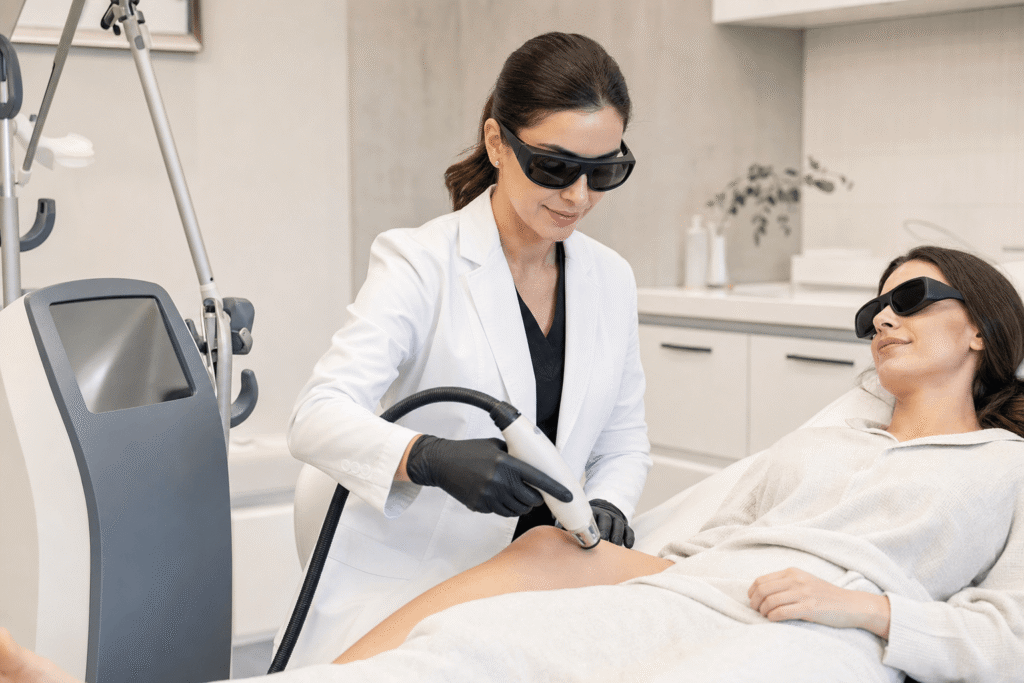
On treatment day, arrive with clean skin, free of lotions, deodorants (for underarm treatments), and makeup (for facial treatments). Your technician will cleanse the area again and may mark treatment boundaries. Protective eyewear is mandatory, even when treating areas far from the face, because scattered laser light can reach eyes.
During treatment, you’ll feel heat and a snapping sensation as the laser fires. Discomfort levels vary by area, with bonier locations (shins, ankles) and sensitive zones (bikini, upper lip) feeling more intense. Modern lasers include cooling mechanisms that help, but some sensation is unavoidable. Pain should never be severe, and if it is, speak up immediately. Excessive pain can signal settings are too high for your skin type.
Post-Treatment Care and Recovery
Immediately after treatment, the area will be red and may be swollen. Your technician will apply cooling gel or ice packs. You should receive written aftercare instructions covering what to expect and when to call with concerns.
Post-treatment care is crucial for preventing complications. Avoid heat (hot showers, saunas, intense exercise) for 24-48 hours as it increases inflammation. Keep the area clean and moisturized. Don’t scratch or pick at the skin. Most importantly, protect treated areas from sun exposure using SPF 30+ sunscreen. UV exposure during the healing period dramatically increases pigmentation change risk.
Hair will shed from treated follicles over 1-3 weeks. This is normal, not regrowth. Between sessions, you can shave but shouldn’t wax, tweeze, or use depilatory creams, as these remove the hair follicle that subsequent treatments need to target.
Treatment intervals matter for both safety and effectiveness. Sessions are typically spaced 4-8 weeks apart depending on body area, allowing skin to fully recover while catching new hairs in their growth phase. Rushing treatments too close together increases complication risk without improving results. For detailed information on optimal timing, see our guide to how long between laser hair removal sessions.
Most patients need 6-8 sessions for significant permanent reduction. Some may need maintenance sessions once or twice yearly. This is normal and doesn’t indicate treatment failure, it reflects hair growth biology and hormonal influences.
At Bright and Beauty Laser Clinic, patients receive detailed pre-treatment instructions at booking and written aftercare protocols after each session. The team encourages questions at every stage, recognizing that informed, engaged patients achieve better outcomes and experience fewer complications.
Safety and What to Expect
Laser hair removal safety comes down to appropriate candidate selection, proper equipment choice, skilled technique, and careful aftercare. When these elements align, the procedure is remarkably safe with a low complication rate and predictable outcomes.
Most patients experience only mild, temporary side effects that resolve within days. The redness, swelling, and slight discomfort immediately following treatment are expected responses, not complications. Your skin just absorbed focused heat energy, so some reaction is inevitable and actually indicates the treatment is working at the follicular level.
Serious complications are rare when treatment follows established safety protocols. Burns, permanent pigmentation changes, and scarring occur in less than 1-2% of properly performed treatments, and even these can often be prevented or managed effectively when caught early.
Your role in safety is significant. Being honest about your medical history, medications, and sun exposure allows your practitioner to adjust protocols accordingly. Following pre-treatment and aftercare instructions directly impacts your risk profile. Communicating during treatment when something feels wrong helps your technician adjust before minor issues become complications.
Choosing a qualified provider is perhaps the single most important safety factor within your control. Certification, experience, appropriate equipment for your skin type, thorough consultation protocols are necessities. The clinic offering the cheapest price or the fastest treatment likely cuts corners somewhere, and those corners affect your safety.
If you experience unexpected symptoms after treatment, severe pain, increasing redness after 48 hours, signs of infection, or blistering, contact your provider immediately. Most issues resolve with simple interventions when addressed early but can worsen if ignored.
The decades of safety data, FDA approval, and millions of successful treatments worldwide establish laser hair removal as a safe, effective option for long-term hair reduction when performed correctly. It’s not risk-free, but the risk-benefit profile strongly favors treatment for appropriate candidates seeking permanent solutions to unwanted hair.
Frequently Asked Questions
Is laser hair removal safe for all skin types?
Laser hair removal can be safe for all skin types when the correct laser type matches your Fitzpatrick skin tone. Lighter skin (types I-III) can safely use alexandrite or diode lasers, while darker skin (types IV-VI) requires Nd:YAG lasers. Using the wrong laser type on darker skin dramatically increases burn and pigmentation risk.
Can laser hair removal cause cancer or long-term health problems?
No, laser hair removal does not cause cancer or long-term health problems. The lasers used emit non-ionizing radiation that doesn’t have sufficient energy to damage DNA. Over 25 years of follow-up data show no increased cancer risk, no impact on fertility, and no long-term health effects.
What are the most common side effects of laser hair removal?
The most common side effects are temporary redness, swelling, and a sunburn-like sensation that resolve within 24-48 hours. About 10-15% of patients experience folliculitis within a week of treatment. Temporary pigmentation changes typically resolve within 3-6 months. Serious complications occur in less than 1-2% of properly performed treatments.
How many laser hair removal treatments will I need and is it safe long-term?
Most patients need 6-8 treatments spaced 4-8 weeks apart for significant permanent hair reduction. Some patients need maintenance sessions once or twice yearly. Long-term safety data spanning 10-15 years shows no delayed complications, no increased health risks, and sustained results.
Is professional laser hair removal safer than at-home devices?
Yes, professional laser hair removal is significantly safer than at-home devices. Professional systems use true lasers with specific wavelengths, higher power, and advanced cooling systems. Trained technicians assess your skin type and adjust settings appropriately. At-home devices are generally weaker IPL systems without professional assessment.
Trust Your Skin to Certified Laser Specialists in North York
Laser hair removal safety depends on the expertise of your practitioner, the appropriateness of equipment for your skin type, and your active participation in pre-treatment and aftercare protocols. At Bright and Beauty Laser Clinic, Soraya brings certified laser expertise and a commitment to individualized assessment, ensuring every patient receives treatment matched to their unique skin characteristics and safety needs. The clinic’s investment in multiple laser systems, including both diode and Nd:YAG options, allows safe treatment across all Fitzpatrick skin types commonly seen in Toronto’s diverse North York community.
Ready to discuss whether laser hair removal is safe for your specific skin type and circumstances? Schedule a consultation at Bright and Beauty Laser Clinic to receive a thorough Fitzpatrick assessment, learn which laser type suits your needs, and get honest answers about what to expect. Call (416) 666-4500 or book online to meet with Soraya and discover how safe, professional laser hair removal can provide lasting results without compromising your skin’s health.