What Is Microneedling? Complete Guide to Collagen Induction Therapy
Microneedling is a minimally invasive cosmetic procedure that uses fine needles to create controlled micro-injuries in the skin’s surface, triggering the body’s natural healing response to produce new collagen and elastin. Also known as collagen induction therapy, this treatment has become one of the most sought-after solutions for acne scars, fine lines, wrinkles, and overall skin texture improvement across Toronto and North York.
If you’re researching whether microneedling is right for your skin concerns, you’re probably wondering how the process actually works, what results you can realistically expect, how much it costs locally, and whether the recovery time fits your lifestyle. This guide covers everything from the science behind collagen induction to treatment protocols, cost breakdowns specific to the Toronto area, and what to expect during and after your sessions.
At Bright and Beauty Laser Clinic in North York, we’ve helped hundreds of clients address skin concerns through professional microneedling treatments customized to individual skin types and goals.
Quick Answer
Microneedling is a skin rejuvenation procedure that uses tiny needles to puncture the skin, stimulating collagen production and cell turnover. It effectively treats acne scars, wrinkles, large pores, and uneven texture with minimal downtime, typically requiring 3-6 sessions spaced 4-6 weeks apart for optimal results.
What Is Microneedling?
Microneedling is a cosmetic procedure that involves using a device equipped with fine, sterile needles to create thousands of microscopic punctures in the skin’s dermis layer. These controlled micro-injuries trigger a powerful regenerative response deep within the tissue.
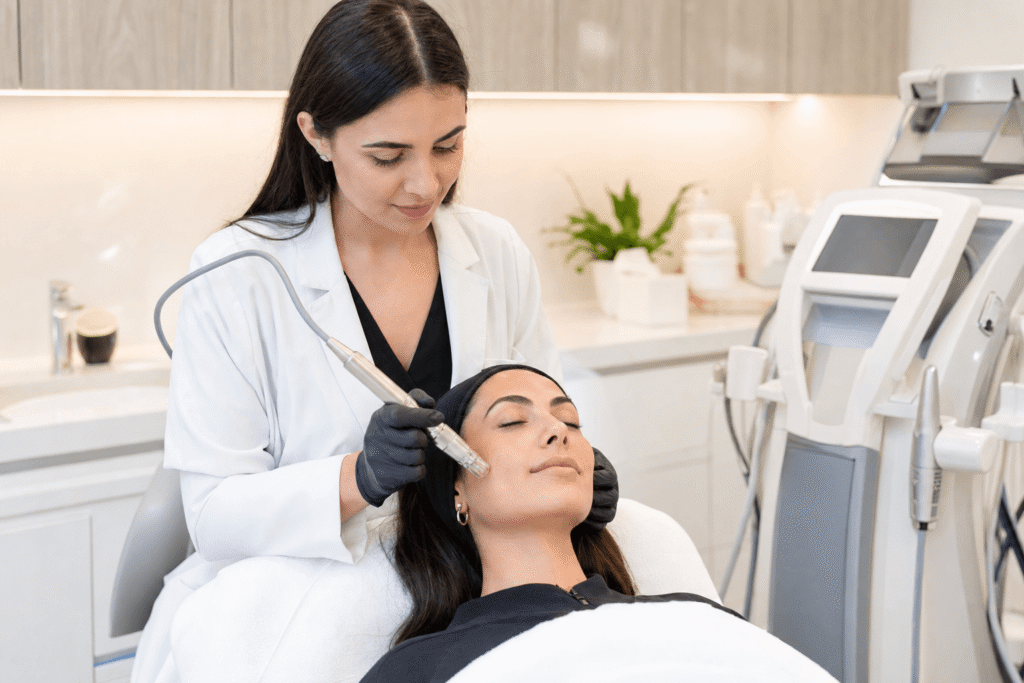
During a professional microneedling session, practitioners use motorized pen-like devices that contain multiple fine needles. These needles typically range from 0.5mm to 2.5mm in length, depending on the treatment area and skin concern being addressed. Deeper penetration targets more severe scarring or wrinkles, while shallower depths work well for texture improvement.
What makes microneedling particularly appealing is its versatility. It works on most skin types and tones when performed correctly, addresses multiple concerns simultaneously, and can be combined with other treatments like platelet-rich plasma (PRP) for enhanced results. At Bright and Beauty Laser Clinic, Soraya evaluates each client’s skin type using the Fitzpatrick scale before recommending needle depth and treatment intensity.
Key Takeaways
- Microneedling creates controlled injuries to stimulate natural collagen production
- Expect visible improvements in 4-6 weeks after treatment sessions
- Plan for 3-6 sessions spaced one month apart for optimal results
- North York costs: $300-$450 per full face session, $500-$700 with PRP
- Downtime is minimal, typically 24-48 hours of redness and sensitivity
How Microneedling Works: The Science Behind Collagen Induction
The science behind microneedling centers on the body’s natural wound-healing cascade. When the needles penetrate the skin, they create micro-channels that the body interprets as injuries requiring repair. This triggers three distinct healing phases.
The first phase is inflammation, occurring immediately after treatment. Your body releases growth factors and cytokines to the treatment area, increasing blood flow. This inflammatory response is essential for triggering the regenerative process. You’ll notice redness and slight swelling during this phase, which typically lasts 24-48 hours.
The proliferation phase follows, lasting roughly 2-3 weeks after treatment. During this period, fibroblast cells in the dermis layer begin producing new collagen and elastin fibers. Your skin also generates new capillaries to improve blood supply to the area.
The remodeling phase extends from about three weeks to six months post-treatment. New collagen continues to form and organize itself into stronger networks. The skin gradually becomes firmer, plumper, and more even in texture and tone. This extended timeline explains why microneedling results improve progressively over several months.
Needle depth significantly impacts results. Shallow penetration (0.5-1.0mm) primarily improves texture and product absorption. Medium depth (1.0-2.0mm) addresses moderate scarring and wrinkles. Deeper penetration (2.0-2.5mm) targets severe acne scars but requires more expertise.
We adjust needle depth based on treatment area and skin concern. Delicate areas like around the eyes need shallower penetration (0.5-1.0mm), while acne-scarred cheeks tolerate deeper treatment (1.5-2.0mm). This customization prevents over-treatment and optimizes collagen response.
What Conditions Does Microneedling Treat?
Microneedling addresses a wide range of skin concerns. The collagen-stimulating mechanism works on multiple issues simultaneously, often improving secondary concerns you weren’t even targeting.
The most common conditions treated include acne scars, fine lines, wrinkles, enlarged pores, uneven skin texture, hyperpigmentation, stretch marks, and mild skin laxity. Each concern responds differently to treatment.
Acne Scars and Hyperpigmentation
Acne scarring represents one of microneedling’s most successful applications. The treatment works particularly well on atrophic scars (depressed scars caused by collagen loss), including boxcar scars, rolling scars, and ice pick scars. Rolling scars typically respond best, often showing 50-75% improvement after a full treatment series.
Hyperpigmentation requires careful approach. Microneedling can improve these conditions by accelerating cell turnover and allowing better penetration of brightening serums. However, aggressive treatment on darker skin tones carries post-inflammatory hyperpigmentation risk if not performed correctly.
Fine Lines, Wrinkles, and Stretch Marks
Fine lines and superficial wrinkles respond well to microneedling because the treatment directly addresses their root cause: collagen degradation. As new collagen forms, skin becomes thicker and more resilient, visibly reducing wrinkle depth. Areas like crow’s feet, forehead lines, and smile lines show noticeable improvement after 3-4 sessions.
Stretch marks present a challenging concern, but microneedling offers some of the best non-surgical improvement available. Multiple sessions over 6-9 months can reduce stretch mark visibility by 30-60%, improving both texture and color blending with surrounding skin.
Combining microneedling with hyaluronic acid or growth factor serums immediately post-treatment significantly enhances results. The micro-channels allow these ingredients to penetrate 20-30 times deeper than topical application alone, amplifying collagen stimulation.
What to Expect During a Microneedling Treatment
Understanding what happens during your appointment helps reduce anxiety and sets realistic expectations. Professional microneedling follows a structured protocol designed to maximize results while ensuring comfort and safety.
Your appointment begins with thorough skin cleansing to remove makeup, oils, and debris. The practitioner then applies a topical anesthetic cream to the treatment area, which sits on the skin for 20-30 minutes. Once the numbing takes effect, the actual microneedling procedure begins. Most clients describe the sensation as moderate pressure with occasional prickling, not sharp pain.
The practitioner moves the microneedling device across your skin in overlapping passes, ensuring complete coverage. Treatment duration varies by area size. A full face typically takes 20-30 minutes, while spot treatments for acne scarring might only require 10-15 minutes. During treatment, you’ll notice your skin becoming progressively pinker or redder. This is normal and expected.
After completing the microneedling passes, the practitioner applies a soothing serum or hyaluronic acid to calm the skin and support healing. Many clinics offer optional platelet-rich plasma (PRP) treatments where your own blood’s growth factors are applied to the freshly treated skin for amplified regenerative benefits. The entire appointment usually takes 60-90 minutes. Your skin will look quite red immediately afterward, similar to a moderate sunburn, but this typically fades significantly within 24 hours.
Ready to book your treatment?
Visit Soraya and the team at our North York clinic for a personalized consultation and professional laser or facial treatment.
Microneedling Recovery and Results Timeline
Recovery from microneedling is relatively quick compared to more aggressive procedures, but knowing what to expect day-by-day helps you plan accordingly and avoid complications.
Day-by-Day Recovery Timeline
Immediately after treatment, your skin will appear red and feel tight, similar to a sunburn. This is the most intense phase of visible recovery. Some people also experience mild swelling, particularly around the eye area. For the first 24 hours, avoid touching your face unnecessarily, and don’t apply makeup or active skincare ingredients.
Days 1-2 bring the most noticeable redness and sensitivity. Stay out of direct sun exposure and skip intense exercise that causes excessive sweating. Many people take these days off work or social commitments. By day 3, redness typically fades to a pink flush that’s easily concealed with mineral makeup if desired. Some people experience light flaking or dryness as the skin begins its renewal process.
Days 4-7 see continued improvement. Most visible side effects resolve completely by the end of the first week. Your skin may feel slightly dry or tight as new skin cells form. You can usually resume normal activities and skincare routines by day 5-7, though you should still use sunscreen religiously.
Results Timeline: When You’ll See Improvement
Understanding the results timeline prevents disappointment and helps you appreciate the gradual transformation microneedling provides. Unlike injectable fillers that offer immediate volume, collagen induction therapy works on your body’s own biological timeline.
Week 1: Your skin looks relatively normal once initial redness subsides, but you probably won’t notice dramatic improvement yet. Some people report a subtle glow or smoother texture from the immediate skin renewal response.
Weeks 2-4: This is when you’ll start seeing initial improvements. Skin texture becomes noticeably smoother, pores appear smaller, and fine lines may look slightly softer. The new collagen is beginning to form during this phase. Many clients report that makeup applies more smoothly and skin has improved overall radiance.
Months 2-3: Improvements become more obvious. Acne scars appear less deep (typically 15-25% improvement per session), wrinkles continue softening, and overall skin quality improves noticeably. Collagen production peaks around this timeframe, delivering the most visible transformation. Before-and-after photos taken at this stage show the most dramatic differences. Clients often notice that hyperpigmentation begins fading and skin tone becomes more even during this period.
Months 4-6: Results continue maturing as collagen remodeling progresses. Skin firmness increases, texture continues refining, and tone becomes more even. For acne scarring specifically, cumulative improvements from multiple sessions become apparent during this period. Clients who completed 4-6 sessions typically see 50-75% overall improvement in scar depth and texture by the 6-month mark. Subtle refinements continue as the new collagen networks fully integrate into the skin structure.
Most protocols recommend 3-6 treatment sessions spaced 4-6 weeks apart for optimal results. The specific number depends on your concern’s severity and your skin’s response. Maintenance treatments every 6-12 months help sustain results as natural aging continues.
Microneedling Effectiveness by Skin Type
Results vary somewhat by skin type according to the Fitzpatrick scale. Understanding these differences helps set realistic expectations and ensures safe, effective treatment customized to your skin.
Lighter skin types (Fitzpatrick I-III) typically see faster visible improvements because they can tolerate more aggressive treatment protocols with shorter intervals between sessions. Post-inflammatory hyperpigmentation risk is minimal, allowing practitioners to use optimal needle depths without concern. These clients often achieve target results in 3-4 sessions and can safely undergo deeper penetration (up to 2.5mm) for severe scarring.
Medium skin tones (Fitzpatrick IV) respond excellently to microneedling but require slightly conservative approaches. Treatment intervals may extend to 6 weeks instead of 4 to ensure complete healing between sessions. Needle depths of 1.5-2.0mm work well for most concerns. Results timeline may be slightly extended, with peak improvements appearing around months 3-4 instead of 2-3. Pre-treatment preparation with brightening agents for 2-3 weeks helps minimize post-inflammatory hyperpigmentation risk.
Darker skin tones (Fitzpatrick V-VI) benefit tremendously from microneedling for acne scarring and texture concerns, but treatment must be carefully calibrated. Shallower needle depths (1.0-1.5mm maximum) and longer intervals (6-8 weeks) prevent excessive inflammation that could trigger hyperpigmentation. Pre-treatment with tyrosinase inhibitors like kojic acid or tranexamic acid for 2-4 weeks helps suppress melanin production. Results timeline extends slightly, with optimal improvements appearing around months 4-6, but final outcomes can be equally impressive when protocols are properly customized. Post-treatment protocols should include continued brightening agents and strict sun protection for 4-6 weeks.
At Bright and Beauty Laser Clinic in North York, Toronto’s diverse population means we regularly treat all Fitzpatrick skin types. Soraya carefully assesses each client’s skin type and adjusts treatment parameters accordingly, ensuring safe, effective results regardless of natural pigmentation level.
Microneedling Risks, Side Effects, and Who Should Avoid It
While microneedling is generally safe when performed by trained professionals, understanding potential risks and contraindications helps you make informed decisions and avoid complications.
Common side effects are typically mild and temporary. These include redness lasting 24-48 hours, slight swelling especially around eyes, pinpoint bleeding during treatment, temporary skin tightness, and mild flaking or dryness during the healing phase. These effects are expected parts of the healing process and resolve without intervention.
Less common but more concerning side effects include prolonged redness lasting beyond a week, post-inflammatory hyperpigmentation (particularly in darker skin tones), infection (rare when proper sterile technique is followed), and adverse reactions to topical products applied during or after treatment. Choosing an experienced provider significantly reduces these risks.
Who Should Avoid Microneedling
Certain people should avoid microneedling or proceed with extra caution. Contraindications include active acne breakouts or infections in the treatment area, active cold sores or herpes simplex, keloid scar tendency, certain autoimmune conditions affecting healing, blood clotting disorders or use of anticoagulant medications, recent isotretinoin use (typically need to wait 6-12 months), and pregnancy or breastfeeding.
People with active skin infections, eczema flare-ups, or psoriasis in the treatment area should postpone treatment until these conditions resolve. Those taking medications that affect healing or increase bleeding risk should discuss their situation with both their doctor and the practitioner before proceeding.
Special Considerations by Skin Type
Fitzpatrick skin types IV-VI (medium brown to deeply pigmented skin) face higher post-inflammatory hyperpigmentation risk if treatment is too aggressive. This doesn’t mean these skin types can’t benefit from microneedling, but it requires experienced practitioners who understand how to adjust treatment parameters appropriately. Conservative needle depths, longer healing intervals, and pre-treatment with brightening agents significantly reduce risk while maintaining excellent results.
At Bright and Beauty Laser Clinic in North York, Soraya evaluates every client’s medical history, current medications, and skin condition before proceeding with microneedling. This screening process identifies potential risk factors and ensures treatment safety. Sometimes we recommend alternative treatments like gentler anti-aging facials for clients with contraindications.
Choosing an experienced, properly trained provider significantly reduces complication risk. Professional settings use sterile, single-use needle cartridges, follow proper disinfection protocols, and understand appropriate needle depths for different skin types. At-home dermarolling devices carry higher infection and scarring risks and should be avoided for serious skin concerns.
Microneedling Cost in North York and Toronto
Understanding the investment required for microneedling helps you budget appropriately and compare value across providers. Pricing varies significantly based on treatment area, needle depth, combination treatments, and provider expertise.
In the North York and greater Toronto area, single microneedling sessions typically range from $250 to $600. Full-face treatments at reputable medical spas and clinics usually fall in the $300-$450 range, while more extensive areas or combination treatments with PRP can reach $500-$700 per session.
Cost Breakdown by Treatment Type
Treatment area size matters significantly. A full face typically costs $300-$450 at established North York clinics. Spot treatment for isolated acne scars covering smaller areas ranges from $250-$350. Face and neck combination treatments increase to $450-$600 because of the larger surface area and additional time required.
Needle depth and treatment intensity also affect cost. Superficial treatments for texture improvement are typically priced at the lower end ($250-$350). Deeper treatments targeting severe acne scarring with needle depths of 2.0-2.5mm require more expertise and longer recovery, justifying higher fees in the $400-$500 range for full face.
Combination treatments add to the base price. Microneedling with platelet-rich plasma (PRP) typically adds $200-$300 to the session cost because it involves blood draw, centrifuge processing, and additional materials. This brings total cost to $500-$700 per session. Treatments with growth factors or specialized serums may add $50-$150 depending on the products used.
Body area treatments like stretch marks on abdomen, thighs, or arms typically range from $400-$650 per session depending on the size of the treatment area. These areas require more time and product, increasing the overall cost.
| Treatment Type | North York/Toronto Price Range | Recommended Sessions | Total Investment |
|---|---|---|---|
| Full Face Standard | $300-$450 | 3-4 sessions | $900-$1,800 |
| Full Face with PRP | $500-$700 | 3-4 sessions | $1,500-$2,800 |
| Spot Treatment (Acne Scars) | $250-$350 | 4-6 sessions | $1,000-$2,100 |
| Face + Neck | $450-$600 | 3-4 sessions | $1,350-$2,400 |
| Body Areas (Stretch Marks) | $400-$650 | 6-8 sessions | $2,400-$5,200 |
Package Deals and Total Investment
Package deals offer cost savings for clients committing to multiple sessions. Many Toronto-area clinics, including Bright and Beauty Laser Clinic, provide discounted packages when you pre-purchase 3-6 treatments. This typically saves 10-20% compared to paying per session. For example, a package of 4 full-face treatments might cost $1,200-$1,400 instead of $1,600 when purchased individually.
The total investment for a complete treatment series typically ranges from $900 to $2,800 depending on your specific needs and whether you choose standard microneedling or combination treatments with PRP. While this represents a significant investment, many clients find the results justify the cost, particularly when comparing microneedling’s effectiveness to less permanent solutions or more expensive laser procedures.
Additional cost considerations include pre-treatment skin preparation products (brightening serums or retinoids) ranging from $30-$80, post-treatment skincare products specifically formulated for healing skin (gentle cleansers, healing serums, mineral sunscreen) totaling $50-$150, and potential travel costs if visiting a reputable clinic outside your immediate area.
Insurance doesn’t typically cover microneedling because it’s considered a cosmetic procedure. Some providers offer financing plans if you need to spread costs over time. At Bright and Beauty Laser Clinic, we provide transparent pricing during your consultation so you can make informed decisions about your treatment plan without surprise fees.
Frequently Asked Questions
What is microneedling and how does it work?
Microneedling uses fine needles to create controlled micro-injuries in the skin, triggering natural healing and collagen production. The tiny punctures stimulate fibroblast cells to produce new collagen and elastin, gradually improving texture, reducing scars, and minimizing wrinkles. The micro-channels also allow topical treatments to penetrate much deeper than on intact skin.
What are the main benefits of microneedling for skin?
Microneedling improves acne scars (typically 50-75% reduction after full treatment series), reduces fine lines and wrinkles, minimizes pores, improves skin texture and firmness, enhances product absorption by 20-30 times, reduces hyperpigmentation, and improves stretch marks. It works on most skin types and addresses multiple concerns simultaneously with minimal downtime of 24-48 hours.
Does microneedling hurt during the procedure?
Most clients find microneedling quite tolerable when performed with topical anesthetic cream applied 20-30 minutes before treatment. The sensation is typically moderate pressure with occasional prickling rather than sharp pain. Bonier areas like the forehead feel more intense than fleshier areas, but the numbing cream makes even aggressive treatments manageable for most people.
How often should you get microneedling treatments?
Sessions should be spaced 4-6 weeks apart to allow complete healing and collagen formation between treatments. Most people need 3-6 sessions for optimal results depending on concern severity. Acne scarring typically requires 4-6 treatments, while fine lines may show excellent results after 3-4 sessions. Maintenance treatments every 6-12 months help sustain improvements long-term.
How long does it take to see results from microneedling?
Initial improvements become noticeable 2-4 weeks after treatment as new collagen begins forming, but results continue developing for 3-6 months as collagen remodeling progresses. Most dramatic changes appear around the 2-3 month mark when collagen production peaks. After completing a full series of 3-6 treatments, cumulative results continue maturing for up to six months post-final session.
Conclusion: Is Microneedling Right for You?
Microneedling offers a scientifically proven, minimally invasive solution for a wide range of skin concerns, from stubborn acne scars to early signs of aging. Its ability to trigger natural collagen production makes it uniquely effective for improving skin quality from within rather than simply treating surface symptoms. With proper treatment planning customized to your specific skin type and concerns, you can achieve significant improvements in texture, tone, and overall skin health with minimal downtime.
If you’re considering microneedling in the North York or Toronto area, schedule a consultation at Bright and Beauty Laser Clinic. Soraya and our experienced team will assess your skin, discuss your goals, and create a customized treatment plan that delivers safe, effective results. Call (416) 666-4500 or visit our convenient North York location to start your journey toward smoother, more radiant skin.