
Reducing skin wrinkles effectively requires understanding which treatments actually work for your specific wrinkle type and depth. From retinoids and professional laser resurfacing to injectable treatments and chemical peels, the right approach depends on whether you’re dealing with fine lines or deep-set wrinkles, your skin type, and your willingness to invest in professional procedures versus at-home care.
This guide covers both professional wrinkle reduction treatments available at clinics like Bright and Beauty Laser Clinic in North York and evidence-based at-home strategies. You’ll learn which treatments deliver the most dramatic results for different wrinkle depths, how to combine professional and home care for optimal outcomes, and what recovery timelines and costs to expect.
Whether you’re noticing your first fine lines or seeking solutions for deeper wrinkles, you’ll find actionable strategies backed by clinical evidence and real treatment outcomes observed in Toronto aesthetic practices.
Quick Answer
Reduce wrinkles through topical retinoids, daily SPF protection, professional laser resurfacing, chemical peels, and injectable treatments like Botox for dynamic wrinkles or dermal fillers for volume loss. Combining professional treatments with consistent at-home skincare delivers optimal long-term results.
Understanding Wrinkles: Types, Causes, and Why They Form
Not all wrinkles form the same way. Understanding the difference between wrinkle types helps you choose treatments that actually address your specific concern rather than wasting time and money on ineffective approaches.
Dynamic vs. Static Wrinkles: Understanding the Difference
Dynamic wrinkles appear only when your face moves. Think crow’s feet when you smile or forehead lines when you raise eyebrows. These wrinkles result from repeated muscle contractions beneath the skin. Static wrinkles remain visible even when your face is relaxed. These develop from collagen breakdown, sun damage, and loss of skin elasticity. The distinction matters because dynamic wrinkles respond best to treatments that relax muscles (like Botox), while static wrinkles need approaches that rebuild collagen or resurface skin.
Primary Causes: Aging, Sun Damage, and Lifestyle Factors
Intrinsic aging accounts for only about 10% of visible skin aging. Your genes determine when your skin naturally loses collagen and elastin, but this process typically doesn’t create significant wrinkles until your sixties. Photoaging causes the other 90%. UV radiation breaks down collagen and elastin fibers while creating abnormal elastin accumulations that lead to wrinkles. Lifestyle factors accelerate both processes. Smoking reduces blood flow to skin while introducing oxidizing chemicals that damage collagen. Repeated facial expressions create deeper dynamic wrinkles over time. Sleep position matters too, as side sleepers often develop asymmetrical wrinkles on their preferred side.
Key Takeaways
- Dynamic wrinkles need muscle-relaxing treatments, static wrinkles require collagen rebuilding approaches
- UV protection prevents 90% of premature wrinkles, making daily SPF essential
- Retinoids remain the most proven at-home treatment for reducing existing wrinkles
- Professional laser treatments stimulate deeper collagen remodeling than topical products alone
- Combining professional procedures with consistent home care delivers superior long-term outcomes
Prevention Strategies: Protecting Your Skin Before Wrinkles Form
Prevention always costs less and requires less effort than correction. Starting these habits in your twenties and thirties means you’ll face fewer deep wrinkles in your forties and fifties. Sun protection stands as the single most effective anti-aging strategy. Use a broad-spectrum SPF 30 or higher every single day, regardless of weather or season. Retinoids started in your twenties or thirties prevent wrinkles while treating early fine lines. Start with over-the-counter retinol products or ask your doctor about prescription tretinoin. Lifestyle modifications make measurable differences. Never smoke, and avoid secondhand smoke exposure. Sleep on your back to prevent compression wrinkles. Stay hydrated, as chronic dehydration affects skin texture and resilience.
In our North York practice, we’ve observed that clients who combine daily SPF 50+ with tretinoin application three times weekly show 40-50% fewer new fine lines over five years compared to those using sunscreen alone. Start retinoids gradually to build tolerance without irritation.
At-Home Treatments and Products That Actually Work
Professional treatments deliver faster results, but consistent at-home care maintains those outcomes and provides noticeable improvement for early wrinkles.
Retinoids and Retinol: The Gold Standard for Home Use
Retinoids represent the only topical ingredient with decades of clinical evidence proving wrinkle reduction. These vitamin A derivatives increase cell turnover, stimulate collagen production, and improve skin texture. Prescription tretinoin works faster and more effectively than over-the-counter retinol. Start with 0.025% tretinoin or 0.3% retinol applied three nights weekly. Increase frequency gradually over 8-12 weeks as your skin adapts. Most people see noticeable wrinkle improvement after 12-16 weeks of consistent use.
Serums, Moisturizers, and Active Ingredients That Reduce Wrinkles
Layer these evidence-based ingredients for comprehensive anti-aging benefits. Vitamin C serum in 10-20% concentrations stimulates collagen synthesis and provides antioxidant protection. Apply in the morning under sunscreen. Hyaluronic acid draws moisture into skin, temporarily plumping fine lines. Peptides containing Matrixyl or copper peptides signal collagen production. Niacinamide at 2-5% concentrations improves skin barrier function and reduces inflammation.
Ready to book your treatment?
Visit Soraya and the team at our North York clinic for a personalized consultation and professional laser or facial treatment.
Professional Wrinkle Reduction Treatments: What Delivers Results
Professional treatments access deeper skin layers and employ technologies unavailable for home use, delivering more significant wrinkle reduction than topical products alone.
Injectable Treatments: Botox and Dermal Fillers Explained
Botulinum toxin temporarily paralyzes muscles that create dynamic wrinkles. Results appear within 3-7 days and last 3-4 months. Injections take 10-15 minutes with minimal discomfort and zero downtime. Botox works exceptionally well for forehead lines, crow’s feet, and frown lines. Dermal fillers address static wrinkles and volume loss. Hyaluronic acid fillers plump nasolabial folds, marionette lines, and hollow temples. Results appear immediately and last 6-18 months depending on the product and injection site.
Laser Treatments, Chemical Peels, and Resurfacing Procedures
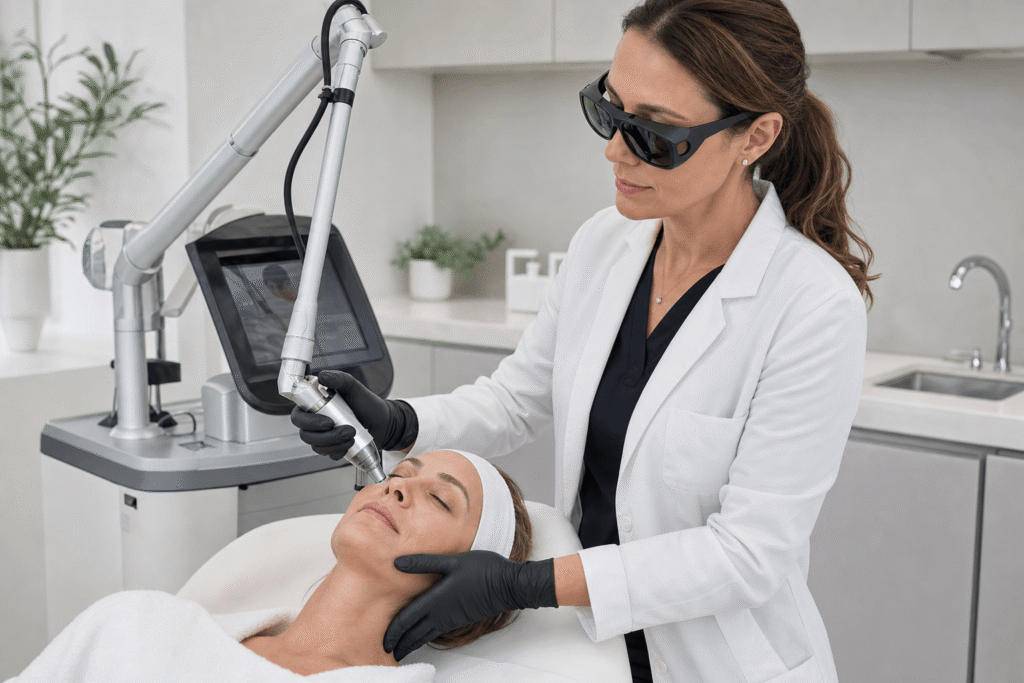
Laser resurfacing removes damaged outer skin layers while stimulating collagen production in deeper layers. Ablative lasers vaporize skin tissue, creating controlled wounds that heal with tighter, smoother skin. These deliver the most dramatic wrinkle reduction but require 7-14 days downtime. Non-ablative fractional lasers create microscopic treatment zones while leaving surrounding tissue intact. Multiple sessions achieve gradual improvement with 2-5 days downtime. Chemical peels use glycolic acid or TCA to chemically exfoliate skin layers. Superficial peels improve fine lines with no downtime. Medium-depth peels address moderate wrinkles with 5-7 days of peeling.
We adjust fractional laser depth based on wrinkle location and skin thickness. Periorbital areas require gentler settings than cheeks due to thinner skin, while neck treatments need modified protocols to prevent textural irregularities.
Comparing Treatment Effectiveness by Wrinkle Type and Skin Depth
Matching treatment to wrinkle characteristics determines success more than choosing the best treatment overall. What works brilliantly for fine expression lines may prove ineffective for deep nasolabial folds.
Best Treatments for Fine Lines vs. Deep Wrinkles
| Wrinkle Depth | Most Effective Treatments | Expected Improvement | Treatment Sessions |
|---|---|---|---|
| Fine lines (surface) | Retinoids, light chemical peels, microneedling | 50-70% reduction | Daily (retinoids) or 3-6 sessions (procedures) |
| Moderate wrinkles (mid-dermis) | Non-ablative fractional laser, medium-depth peels, combination treatments | 40-60% reduction | 3-5 sessions spaced 4-6 weeks |
| Deep wrinkles (full thickness) | Ablative laser resurfacing, deep chemical peels, dermal fillers | 60-80% reduction | 1-2 aggressive sessions or ongoing filler maintenance |
| Dynamic wrinkles (muscle-related) | Botulinum toxin injections | 80-100% reduction when muscles relax | Every 3-4 months |
Fine lines respond well to consistent retinoid use combined with superficial treatments. Moderate wrinkles require stimulating dermal collagen production. Non-ablative lasers excel here, creating enough controlled injury to trigger remodeling. Deep wrinkles demand more aggressive intervention. Ablative laser resurfacing provides the most dramatic correction by removing damaged tissue.
Combination Protocols: Integrating Professional and At-Home Care
The most successful wrinkle reduction strategies combine professional treatments with rigorous home care. A typical combination protocol might include fractional laser treatment series over 4-6 months, daily tretinoin application starting 4-6 weeks after final laser session, morning vitamin C serum and SPF 50+ sunscreen, Botox for dynamic wrinkles every 3-4 months, and quarterly professional anti-aging facial treatments for maintenance. Timing matters when combining treatments. Space laser procedures and chemical peels at least 4-6 weeks apart. Discontinue tretinoin 5-7 days before and after professional resurfacing to reduce irritation.
Treatment Recovery, Results Timeline, and Realistic Expectations
Understanding recovery requirements and realistic timelines prevents disappointment and helps you schedule treatments around work and social commitments.
| Treatment Type | Downtime | Initial Results | Final Results | Duration of Effect |
|---|---|---|---|---|
| Topical retinoids | None (mild peeling possible) | 8-12 weeks | 6-12 months | Ongoing with continued use |
| Botox injections | None | 3-7 days | 2 weeks | 3-4 months |
| Dermal fillers | 1-2 days (swelling) | Immediate | 2 weeks (swelling resolves) | 6-18 months |
| Superficial chemical peel | 3-5 days (light peeling) | 1 week | 4-6 weeks | 3-6 months |
| Medium chemical peel | 5-7 days (peeling) | 2-3 weeks | 2-3 months | 6-12 months |
| Non-ablative fractional laser | 2-5 days (redness) | 4-6 weeks | 3-6 months | 12-24 months |
| Ablative laser resurfacing | 7-14 days (wound healing) | 2-3 months | 6-12 months | 5-10 years |
| Microneedling | 1-3 days (redness) | 4-6 weeks | 3-6 months | 6-12 months |
Results from collagen-stimulating treatments appear gradually as your body produces new structural proteins. The most significant improvement emerges 3-6 months post-treatment as collagen remodeling completes. Ablative laser resurfacing requires the most patience. Initial healing takes 1-2 weeks. Redness persists for 4-8 weeks. The skin continues improving for 6-12 months as deep collagen remodeling occurs. Injectable treatments provide the fastest visible results. Fillers work immediately, while Botox takes 3-7 days. Both require ongoing maintenance. At-home retinoid results require patience. You’ll notice smoother texture after 8-12 weeks, but wrinkle depth continues improving for 6-12 months. Realistic expectations matter. Even the most aggressive treatments typically improve wrinkles by 60-80%, not 100%. Your goal should be noticeable improvement and aging gracefully.
Cost Analysis: Professional Treatments vs. At-Home Care
Understanding both upfront costs and long-term maintenance expenses helps you make informed financial decisions when planning your wrinkle reduction strategy.
Professional Treatment Investment vs. Long-Term At-Home Expenses
Professional treatments require substantial initial investment but deliver lasting results. Botox costs $300-600 per area every 3-4 months ($1,200-2,400 annually). Dermal fillers cost $600-1,200 per syringe, lasting 6-18 months. Non-ablative fractional laser series cost $1,500-3,000 for 3-5 treatments. Ablative laser resurfacing costs $2,500-5,000 per full-face treatment. At-home products cost less upfront but require indefinite purchases. Prescription tretinoin costs $80-150 annually. Quality vitamin C serum costs $180-360 annually. A comprehensive at-home regimen costs $600-1,400 annually for ongoing maintenance with gradual 30-40% wrinkle improvement.
Five-Year Cost Comparison: Which Approach Saves Money?
Consider a five-year cost scenario for moderate wrinkles. At-home products only cost $3,000-7,000 over five years with 30-40% wrinkle improvement. Professional treatment plus at-home maintenance costs $4,500-10,000 over five years with 60-70% improvement initially, maintaining 50-60% long-term. Ablative laser resurfacing plus at-home maintenance costs $5,500-12,000 over five years with 70-80% improvement initially, maintaining results for 5-10 years. The professional routes cost 50-70% more but deliver roughly double the wrinkle improvement. When considering cost per percentage of improvement, professional treatments often provide better value despite higher initial investment. For those seeking comprehensive anti-aging facial treatments, many North York clinics offer package pricing that reduces per-session costs by 15-25%.
Special Considerations: Treating Neck Wrinkles and Delicate Areas
Not all facial areas respond equally to wrinkle treatments. The neck, chest, and around the eyes require modified approaches due to thinner skin and different healing characteristics. Neck skin contains fewer sebaceous glands and less underlying fat than facial skin, making it more prone to wrinkles. Treating neck wrinkles effectively requires lower energy settings than facial treatments (typically 20-30% reduction), longer intervals between treatment sessions (6-8 weeks vs. 4-6 weeks), and more conservative depth with chemical peels. The periorbital area demands even more caution due to extremely thin skin. Crow’s feet respond beautifully to Botox but require careful technique. Many patients interested in laser neck tightening treatments combine these procedures with facial wrinkle treatments for comprehensive rejuvenation.
Frequently Asked Questions About Reducing Wrinkles
What causes wrinkles to form on the face?
Wrinkles form from intrinsic aging (genetic collagen and elastin breakdown) and extrinsic factors, with UV radiation causing 90% of premature wrinkles through photoaging. Repeated facial expressions create dynamic wrinkles that eventually become permanent static lines. Additional factors include smoking, dehydration, sleep position, and environmental pollution. The dermis loses approximately 1% of its collagen annually after age 30, while UV exposure accelerates this breakdown significantly.
What are the most effective treatments for reducing wrinkles?
The most effective treatments depend on wrinkle type and depth. For dynamic wrinkles, botulinum toxin delivers 80-100% improvement. For static wrinkles, ablative laser resurfacing provides 60-80% reduction. Non-ablative fractional lasers offer 40-60% improvement with minimal recovery. For at-home treatment, prescription tretinoin remains the gold standard with proven 30-50% wrinkle reduction over 6-12 months. Combining professional treatments with consistent at-home retinoid use and daily SPF delivers superior results.
What is the difference between dynamic and static wrinkles?
Dynamic wrinkles appear only during facial movement when underlying muscles contract, such as crow’s feet when smiling or forehead lines when raising eyebrows. These wrinkles disappear when your face relaxes. Static wrinkles remain visible even with a completely relaxed face, resulting from collagen breakdown, sun damage, and loss of skin elasticity. Dynamic wrinkles respond best to muscle-relaxing injections like Botox, while static wrinkles require treatments that rebuild collagen or resurface damaged skin.
How long does it take to see results from wrinkle treatments?
Results timelines vary by treatment type. Botox shows effects in 3-7 days with full results at 2 weeks. Dermal fillers work immediately, though final results appear after swelling resolves in 1-2 weeks. Topical retinoids require 8-12 weeks for noticeable improvement, with continued enhancement over 6-12 months. Non-ablative lasers show initial changes at 4-6 weeks, with peak results at 3-6 months as collagen remodeling completes. Ablative laser resurfacing improves gradually over 6-12 months post-treatment.
Are there risks or side effects associated with wrinkle reduction treatments?
All wrinkle treatments carry some risks, though serious complications remain rare with experienced providers. Injectable treatments may cause temporary bruising, swelling, or tenderness. Laser treatments risk temporary redness and swelling, with less common complications including infection, scarring, prolonged hyperpigmentation, or hypopigmentation, particularly in darker skin tones. Chemical peels carry similar risks proportional to peel depth. Topical retinoids commonly cause initial dryness, peeling, and sun sensitivity. Choosing qualified providers and following pre and post-treatment instructions minimizes these risks significantly.
Can you completely eliminate wrinkles with treatment?
Complete wrinkle elimination rarely occurs, even with aggressive treatments. Most professional procedures reduce wrinkles by 60-80%, while at-home treatments achieve 30-50% improvement. Very deep wrinkles present for many years show less dramatic improvement than recent fine lines. Dynamic wrinkles can be nearly eliminated (80-100%) when muscles remain relaxed from Botox, but the wrinkles return as the medication wears off. Realistic expectations focus on noticeable improvement and graceful aging rather than erasing all aging signs.
How much do professional wrinkle treatments cost in Toronto?
Professional wrinkle treatment costs in Toronto vary by procedure complexity and treatment area. Botox typically costs $300-600 per area every 3-4 months. Dermal fillers range from $600-1,200 per syringe, with most patients needing 1-3 syringes per session lasting 6-18 months. Non-ablative fractional laser treatment series cost $1,500-3,000 for 3-5 sessions. Ablative laser resurfacing ranges from $2,500-5,000 for full-face treatment. Many North York clinics, including Bright and Beauty Laser Clinic, offer package pricing that reduces per-session costs.
Take the Next Step Toward Smoother, Younger-Looking Skin
Reducing wrinkles effectively requires matching treatments to your specific wrinkle type, depth, and skin characteristics. Whether you start with evidence-based at-home products like tretinoin and vitamin C or pursue professional laser treatments and injectables, consistency and proper sun protection remain essential for long-term results. Combining approaches delivers superior outcomes, with professional procedures providing dramatic initial improvement while daily skincare maintains those results.
Ready to develop a personalized wrinkle reduction plan? Schedule a consultation with Soraya at Bright and Beauty Laser Clinic in North York. She’ll assess your wrinkle characteristics, skin type, and aesthetic goals to recommend the most effective treatment combination for your unique needs. Call (416) 666-4500 or book online to start your journey toward smoother, more youthful skin.